Understanding AMANN's raw material framework
Intro
There is no single “green material” that solves every circularity challenge.
Different applications have different requirements, and materials come with different strengths and trade-offs. Depending on the application, factors such as raw material source, end-of-life behaviour, technical performance, availability, cost and future regulatory requirements all need to be considered.
This means that a circular product strategy requires different approaches for different challenges. AMANN therefore evaluates material options holistically rather than focusing on a single sustainability criterion.
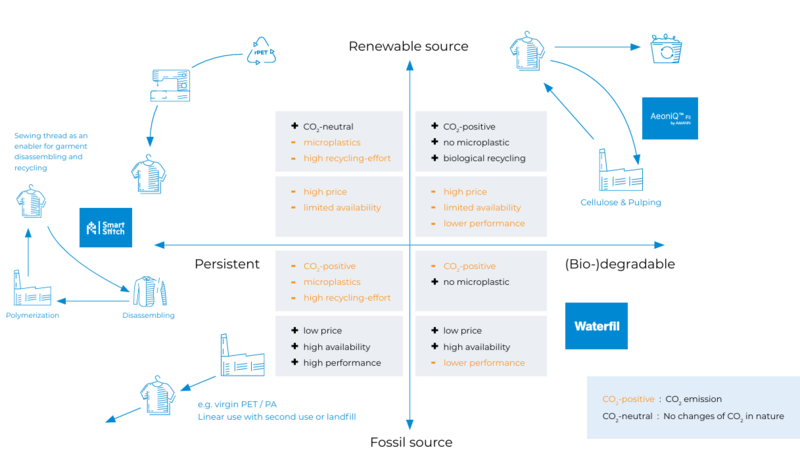
The framework below helps illustrate how different material concepts can be compared and where they can contribute to circularity.
Short definition
AMANN's raw material framework is a tool for evaluating different material pathways based on their raw material source and end-of-life behaviour. It helps illustrate how renewable and fossil-based materials, as well as persistent and (bio-)degradable materials, can contribute to different circularity approaches and where specific trade-offs need to be considered.
Why does this matter?
Choosing a material is not simply a question of whether it is renewable, fossil-based, biodegradable or persistent. Different materials can offer different advantages depending on the product, application and end-of-life pathway.
AMANN’s framework helps make these differences and trade-offs more visible. This supports a more holistic approach to circular product development instead of focusing on a single sustainability characteristic.
Understanding the framework
The framework compares different material concepts along two key dimensions:
- Raw material source – renewable or fossil-based
- End-of-life behaviour – persistent or (bio-)degradable
These dimensions provide a starting point for understanding different material pathways. They do not, however, determine whether one material is universally better than another. AMANN also considers technical requirements, product performance, market availability, cost, customer expectations and evolving regulatory requirements when evaluating materials for future applications.
Different solutions for different circularity challenges
AMANN's portfolio illustrates how different approaches can contribute to circularity:
- Lifecycle products keep valuable materials circulating in technical cycles through Cradle to Cradle Certified® design.
- AeoniQ™ Fil uses renewable cellulose-based feedstocks and is designed to be biologically degradable.
- Waterfil uses biodegradable materials to avoid persistent microplastic emissions.
- Smart Stitch™ supports circularity by enabling garments to be disassembled for more efficient material recovery and recycling.
These solutions address different challenges – from the choice of raw material to product design and end-of-life.
The framework therefore serves as a tool to understand and visualize the different pathways, while AMANN's circularity strategy is built around selecting the approach that best fits the specific application and its requirements.
Key Takeaway
There is no single material solution for circularity. AMANN’s raw material framework helps visualize different material pathways and their trade-offs, considering both raw material source and end-of-life behaviour. The right solution ultimately depends on the specific application, technical requirements and intended circularity pathway.
Cradle to cradle
Intro
Creating products for a circular economy requires looking beyond a product's first use phase. The Cradle to Cradle Certified® framework provides a holistic approach to designing products that can remain valuable resources within biological or technical cycles.
Instead of focusing only on reducing negative impacts, Cradle to Cradle aims to create products that are safe, circular and designed for continuous improvement.
Short definition
Cradle to Cradle Certified® is a product certification framework that assesses products across multiple sustainability categories, including material health, product circularity, climate, water and soil stewardship, and social fairness. It supports the development of products that are designed for safe use, circular material flows and continuous improvement.
A holistic approach to product sustainability
Unlike approaches that focus on a single sustainability aspect, Cradle to Cradle Certified® evaluates products across five sustainability categories:
- Material Health – assessing materials for their potential impact on human health and the environment
- Product Circularity – supporting circular material flows and future reuse
- Clean Air & Climate Protection – addressing environmental impacts and emissions
- Water & Soil Stewardship – promoting responsible resource management
- Social Fairness – considering social responsibility throughout the value chain
This holistic approach considers sustainability throughout the product lifecycle – from material selection to future circular use.
Material Health: choosing safer materials
Material selection plays a critical role in creating products designed for a circular economy. Within Cradle to Cradle Certified®, Material Health assesses the ingredients used in a product and their potential impact on human health and the environment.
The aim is not only to restrict hazardous substances, but to understand the materials used and identify opportunities to select safer alternatives that are suitable for continued circular use.
At AMANN, Material Health supports our approach to responsible product development. By examining the individual components of a sewing thread – from raw materials and dyes to finishing agents – we can identify improvement opportunities and replace critical substances with safer alternatives.
Our Lifecycle Polyamide product was awarded Material Health Platinum, demonstrating that high product performance and ambitious material safety goals can be achieved together.
AMANN's Cradle to Cradle Certified® products
AMANN was the first sewing thread manufacturer worldwide to offer Cradle to Cradle Certified® Gold sewing threads.
Today, our Lifecycle product family includes certified solutions based on different material platforms, such as Lifecycle Polyamide.
This product family is Cradle to Cradle Certified® Gold and designed according to circular economy principles.
As our sustainable product portfolio continues to grow, AMANN evaluates additional products and technologies that can support more circular product concepts.
What does Cradle to Cradle mean for customers?
Cradle to Cradle Certified® products can provide companies with a trusted foundation for developing more circular products and improving material transparency.
For brands and manufacturers, choosing certified materials can help:
- Support circular product design
- Increase material transparency
- Strengthen sustainability communication
- Prepare for future circular economy requirements
- Demonstrate the use of independently certified materials
For companies developing products with circular ambitions, certified sewing threads are one building block of a more circular product – because every component contributes to the overall material concept.
Key Takeaway
Cradle to Cradle looks at products as potential resources for future cycles rather than products with a one-way life. By assessing material health, circularity, climate, water and social aspects, the framework supports safer material choices, circular product design and continuous improvement.
Circular design
Intro
Can a sewing thread make a garment easier to recycle?
It can. Circularity is not only about the materials used in a product – how a product is designed can also influence what happens to it at the end of its useful life.
For textiles, circular design means considering the entire product lifecycle, including how garments can be repaired, reused, disassembled and recycled.
Short definition
Circular design means designing products with their entire lifecycle in mind, including repair, reuse, disassembly, recycling and material recovery. In textiles, design choices such as material selection, construction methods and sewing threads can influence how easily different components can be separated and recovered at the end of a product’s useful life.
Why does this matter?
Many textile products combine different materials and components. This can make them difficult to separate at the end of their useful life and can limit the quality of material recovery.
Designing products with their next stage already in mind can help keep valuable materials in circulation for longer and make recovery processes more effective.
Designing for disassembly
One of the challenges in textile recycling is separating different materials at the end of a product's life. While garments are designed for durability, they are often not designed for easy disassembly, making high-quality recycling more difficult.
Smart Stitch™ addresses this challenge by enabling Design for Disassembly through a heat-dissolvable sewing thread.
At a defined temperature, the thread dissolves, allowing textile components to be separated into cleaner material streams during recycling processes. Developed by Belgian company Resortecs and produced by AMANN, Smart Stitch™ works together with Resortecs' Smart Disassembly™ technology.
In practice at AMANN
The collaboration with Resortecs shows how a relatively small product component can contribute to the circularity of a finished textile product.
Smart Stitch™ can support:
- Easier disassembly of textile components
- More efficient material separation for recycling
- Recovery and reuse of materials from garments
- Cleaner material streams for higher-quality recycling
Interested in the technology and the collaboration behind it?
Watch the Resortecs collaboration announcement video:
What does this mean for customers?
Circular design can open up new possibilities for customers developing products with recycling, material recovery or end-of-life in mind.
The right solution depends on the product construction, materials, intended use and available end-of-life processes. Sewing thread can be one of several design elements that help make a product more compatible with a circular approach.
Key Takeaway
Circularity starts at the design stage. Choosing the right materials, components and construction methods can make products easier to repair, disassemble, reuse and recycle.
Explore next
Quick facts
| Property | Value |
|---|---|
| Topic | Circular products |
| Main framework | AMANN's raw material framework |
| Key concept | Circularity across the product lifecycle |
| Material categories | Renewable, fossil-based, persistent and (bio-)degradable |
| Certification | Cradle to Cradle Certified® |
| Key assessment area | Material Health |
| Circular design principle | Design for Disassembly |
| Key technology | Smart Stitch™ |
| Main objective | Keeping materials in circulation and enabling material recovery |
Also known as
Technical terms
- Circular products
- Circular product design
- Circular economy
- Circularity
- Design for Circularity
- Design for Disassembly (DfD)
- Material circularity
- Product lifecycle
- Material recovery
- End-of-life (EoL)
- Cradle to Cradle Certified®
- Material Health
- Renewable raw materials
- Fossil-based materials
- Biodegradable materials
- Persistent materials
- Textile recycling
- Recyclable textiles
Circular materials
Common descriptions
People often search for:
- What are circular products?
- What is circular product design?
- How does circular design work?
- How can textiles be designed for recycling?
- What is Design for Disassembly?
- How can sewing thread improve textile recyclability?
- What is Cradle to Cradle Certified®?
- What does Cradle to Cradle mean for products?
- What is Material Health?
- What is the difference between bio-based and biodegradable materials?
- Are renewable materials always more sustainable?
- How can textile components be separated for recycling?
- What is the role of sewing thread in circular fashion?
- How can companies design products for a circular economy?
What is the difference between recyclable and biodegradable materials?
Alternative terminology
Different industries and software providers may use slightly different terminology.
- Circular product development
- Circular product strategy
- Circular design principles
- Design for circularity
- Design for recycling
- Design for recyclability
- Design for disassembly
- Design for material recovery
- Circular textile design
- Circular fashion
- Sustainable product design
- Sustainable materials
- Responsible material selection
- Material health assessment
- Product circularity assessment
- End-of-life design
- Textile-to-textile recycling
- Closed-loop material cycles
- Resource-efficient product design
- Circular economy product development
International terminology
| Language | Common terminology |
|---|---|
| English | Circular products; circular design; circular economy; Design for Disassembly; Cradle to Cradle Certified®; material health; material recovery |
| German | Kreislauffähige Produkte; zirkuläres Design; Kreislaufwirtschaft; Design for Disassembly / demontagegerechtes Design; Cradle to Cradle Certified®; Materialgesundheit; Materialrückgewinnung |
| French | Produits circulaires; écoconception circulaire; économie circulaire; conception pour le démontage; Cradle to Cradle Certified®; santé des matériaux; récupération des matériaux |
| Italian | Prodotti circolari; progettazione circolare; economia circolare; progettazione per il disassemblaggio; Cradle to Cradle Certified®; salubrità dei materiali; recupero dei materiali |
| Spanish | Productos circulares; diseño circular; economía circular; diseño para el desmontaje; Cradle to Cradle Certified®; salud de los materiales; recuperación de materiales |
| Chinese | 循环产品; 循环设计; 循环经济; 面向拆解的设计; Cradle to Cradle Certified®; 材料健康; 材料回收 |
| Vietnamese | Sản phẩm tuần hoàn; thiết kế tuần hoàn; kinh tế tuần hoàn; thiết kế để tháo rời; Cradle to Cradle Certified®; mức độ an toàn của vật liệu; thu hồi vật liệu |
FAQ
-
Circular products are designed with their entire lifecycle in mind. They aim to keep valuable materials in use through approaches such as repair, reuse, disassembly and recycling.
-
Circular design considers how a product is made, used and handled at the end of its useful life. It includes material selection, product construction, repair, disassembly and material recovery.
-
Materials differ in their raw material sources, technical properties and end-of-life behaviour. The right choice depends on the product, its intended use and the available recovery processes.
-
Not necessarily. Renewable and fossil-based materials can have different strengths and trade-offs. A holistic assessment also considers technical performance, availability, cost and end-of-life behaviour.
-
Cradle to Cradle Certified® is a product certification framework that assesses five sustainability categories: Material Health, Product Circularity, Clean Air & Climate Protection, Water & Soil Stewardship, and Social Fairness.
-
Material Health assesses the ingredients in a product and their potential impacts on human health and the environment. It helps identify opportunities to use safer materials.
-
Sewing thread can influence how easily garment components can be separated. Heat-dissolvable threads such as Smart Stitch™ can support disassembly and help create cleaner material streams for recycling.
-
Biodegradable materials are designed to break down under suitable conditions, while recyclable materials can be processed to recover material for further use. These are different properties, and neither automatically guarantees that a material is suitable for every circularity pathway.