Intro
What does sustainability mean for a business?
Sustainability is about creating long-term value while considering environmental, social and economic impacts. For a company, this means looking beyond short-term results and taking into account how decisions affect people, the planet and the ability of the business to thrive over time.
Short definition
A sustainability strategy defines how a company integrates environmental, social and economic considerations into its business decisions and long-term goals. It helps turn sustainability priorities into clear areas of action across the business and its value chain.
Why does this matter?
A sustainability strategy helps turn these broad challenges into clear priorities, goals and actions. It provides a framework for understanding how different topics are connected and where a company can make the greatest contribution.
The Sustainable Development Goals
The 17 Sustainable Development Goals (SDGs) of the United Nations provide a globally recognized framework for addressing the world's most pressing social, environmental and economic challenges.
The goals cover areas such as climate action, clean water, responsible consumption, decent work, reduced inequalities and sustainable communities. They are interconnected and are intended to be considered as part of a broader system rather than as isolated targets.
At AMANN, the SDGs are at the centre of our sustainability strategy and help provide orientation when defining priorities and areas for action.
The SDG “Wedding Cake” model
How are the SDGs connected?
The SDG “Wedding Cake” model, developed by the Stockholm Resilience Centre, illustrates the relationships between the 17 SDGs by grouping them into three interconnected layers: Biosphere, Society and Economy.
The model highlights an important principle: the economy and society depend on a healthy biosphere. Environmental conditions form the foundation on which social systems and economic activity can thrive. The SDGs therefore reinforce one another and should be considered as part of one interconnected system.
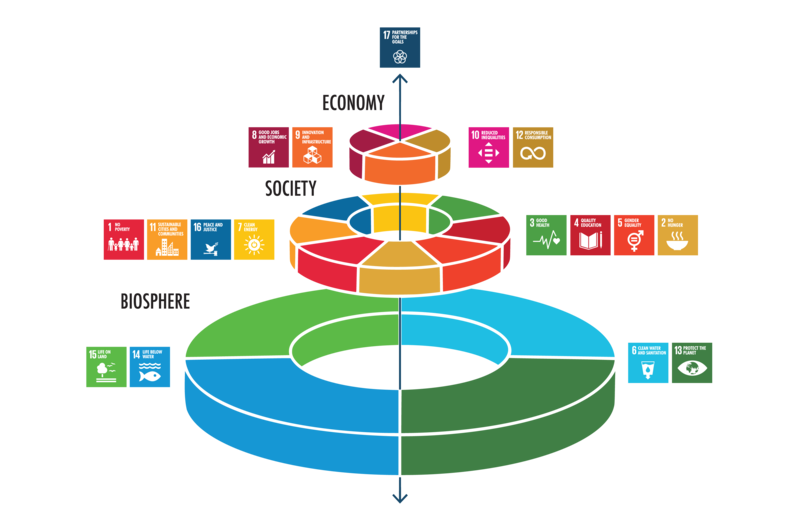
AMANN uses this model as a holistic tool for understanding relationships between sustainability topics and setting strategic priorities.
The Triple Bottom line
The Triple Bottom Line (TBL) is a way of looking at business performance beyond financial results. It recognizes that long-term business success depends on creating value not only for the business, but also for people and the planet.
It considers three interconnected dimensions:
People – considering employees, communities, human rights, health and safety, and social well-being.
Planet – reducing environmental impacts, using resources responsibly and addressing issues such as climate change, pollution and biodiversity.
Profit – maintaining economic viability and creating long-term value so that a business can continue to invest, innovate and develop.
The key idea is that People, Planet and Profit are equally relevant dimensions of sustainable business performance. They should not be considered in isolation or treated as competing priorities by default. Instead, the TBL approach encourages businesses to consider their impacts across all three dimensions, identify potential trade-offs and seek solutions that create long-term value across the whole system.
At AMANN, this principle is expressed through our “true Triple Bottom Line” approach: integrating people, planet and profit into how we make decisions and create long-term value. This means looking beyond short-term financial performance and considering the social and environmental value and impacts of our business alongside economic viability.
Three strategic areas of focus
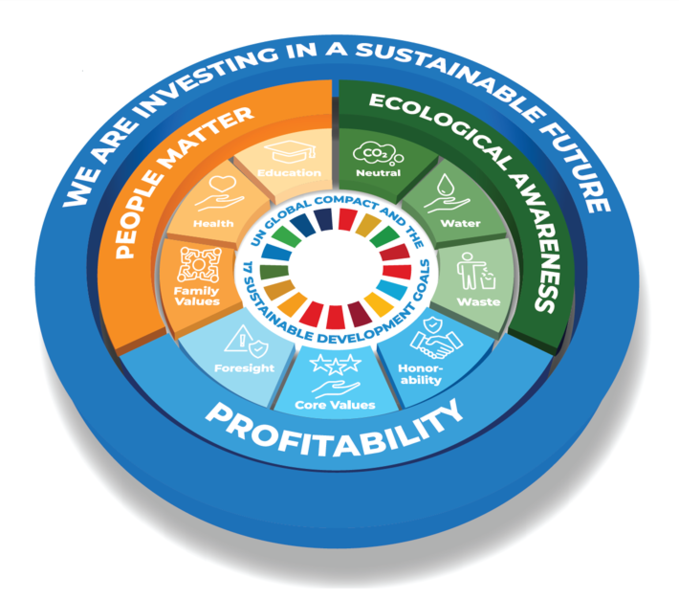
Ecological Awareness
We aim to reduce the environmental impact of our activities and use resources more responsibly. Key topics include climate protection, water, waste, circularity and sustainable materials.
Our activities range from increasing the use of renewable energy and improving resource efficiency to reducing greenhouse gas emissions across the value chain and developing product solutions that combine sustainability with the performance our customers expect.
People Matter
Sustainability also means creating an environment in which people can thrive. AMANN focuses on areas such as health and safety, education, diversity and equal opportunities, as well as its responsibility towards the communities in which it operates.
Profitability
For AMANN, economic sustainability means remaining a strong and future-oriented company that can continue to invest in innovation, responsibility and long-term development.
Customer focus, efficient processes and responsible business decisions are key foundations for sustainable profitability.
Sustainability across the value chain
AMANN's sustainability activities extend across the entire value chain – from raw material sourcing and production at AMANN sites to transportation and delivery to customers.
This requires collaboration across functions and with external partners. Responsible sourcing, resource-efficient production, product development, reliable data and evolving customer requirements all contribute to making our value chain more resilient and future-ready.
Key Takeaway
The Triple Bottom Line recognizes People, Planet and Profit as three equally important and interconnected dimensions of sustainable business success. At AMANN, this means integrating environmental, social and economic considerations into our decisions and actions to create long-term value across our business and value chain.
Explore next
Quick facts
| Property | Value |
|---|---|
| Topic | Triple Bottom Line |
| Key framework | People, Planet, Profit |
| Core dimensions | United Nations Sustainable Development Goals (SDGs) |
| Global framework | Holistic and long-term |
| Key areas | Ecological Awareness, People Matter, Profitability |
| Scope | Business and entire value chain |
| Key considerations | Environmental, social and economic impacts |
| Goal | Long-term value and sustainable business development |
Also known as
Technical terms
- Sustainability strategy
- Corporate sustainability strategy
- Sustainable business strategy
- Business sustainability strategy
- Corporate sustainability
- Sustainable business development
- Sustainability management
- Sustainability framework
- ESG strategy
- Sustainability goals
- Sustainability targets
- Triple Bottom Line (TBL)
- People, Planet, Profit
- Sustainable Development Goals (SDGs)
Common descriptions
People often search for:
- Corporate approach to sustainability
- Strategic approach to sustainable business
- Integrating sustainability into business strategy
- Long-term sustainability planning
- Sustainability priorities and actions
- Environmental, social and economic sustainability
- Sustainable business development and long-term value creation
- Sustainability across the value chain
- Sustainability goals and targets
- Corporate environmental and social responsibility
- Business strategy for sustainable development
- Holistic sustainability approach
- Sustainability management and implementation
- People, Planet and Profit approach
- SDG-based sustainability strategy
- Integrating ESG and sustainability into business decisions
Alternative terminology
Different industries and software providers may use slightly different terminology.
- Sustainable business strategy
- Corporate sustainability approach
- Sustainability management strategy
- ESG strategy
- Sustainable growth strategy
- Long-term sustainability strategy
International terminology
| Language | Common terminology |
|---|---|
| English | Sustainability strategy, Corporate sustainability strategy, Sustainable business strategy |
| German | Nachhaltigkeitsstrategie, Nachhaltigkeitsstrategie eines Unternehmens, Nachhaltiges Wirtschaften |
| French | Stratégie de durabilité, Stratégie de développement durable, Stratégie RSE |
| Italian | Strategia di sostenibilità, Strategia di sostenibilità aziendale |
| Spanish | Estrategia de sostenibilidad, Estrategia de sostenibilidad empresarial |
| Chinese | 可持续发展战略, 企业可持续发展战略 |
| Vietnamese | Chiến lược phát triển bền vững, Chiến lược bền vững của doanh nghiệp |
FAQ
-
A sustainability strategy defines how a company addresses environmental, social and economic impacts as part of its business activities and long-term development. It sets priorities, goals and actions to create long-term value while considering impacts across the business and its value chain.
-
A sustainability strategy helps a company turn broad sustainability challenges into clear priorities and actions. It provides a framework for integrating sustainability into decision-making, managing risks and opportunities, and supporting long-term business resilience.
-
The three dimensions are commonly described as People, Planet and Profit. The Triple Bottom Line approach considers social, environmental and economic aspects together rather than focusing on financial performance alone.
-
The Triple Bottom Line (TBL) is a framework for understanding business performance through three interconnected dimensions: People, Planet and Profit. It encourages companies to consider social and environmental impacts alongside economic viability when making decisions and creating long-term value.
-
People refers to social aspects such as employees, human rights, health and safety and communities. Planet covers environmental impacts such as climate change, resource use, water, waste and biodiversity. Profit represents economic viability and the ability of a company to create value, invest and remain successful over the long term.
-
The 17 Sustainable Development Goals (SDGs) were established by the United Nations as a global framework for addressing social, environmental and economic challenges. They cover topics including climate action, clean water, decent work, responsible consumption and sustainable communities.
-
The SDGs can provide orientation for defining sustainability priorities and areas of action. Their interconnected nature encourages companies to consider environmental, social and economic topics as part of a broader system rather than addressing individual sustainability issues in isolation.
-
Implementation starts by identifying relevant sustainability impacts, priorities and goals. These can then be translated into concrete actions across areas such as operations, sourcing, products, people and the wider value chain, supported by appropriate data, responsibilities and progress tracking.