Intro
Certifications and standards help make quality, safety and sustainability requirements more transparent and verifiable. At AMANN, they cover different areas – from quality and environmental management to product safety, recycled materials, circularity and responsible supply chains.
AMANN takes a targeted approach to certifications and management systems. Rather than pursuing every available certification at every location, we apply standards where they create relevant value for customers, support regulatory or industry requirements, or strengthen our sustainability approach.
Short definition
Certifications and standards provide defined frameworks for assessing, verifying or managing specific requirements related to products, production sites, management systems or supply chains.
Our certification landscape
Our certification landscape can be grouped into three areas:
- Operational Excellence & Compliance – quality, environmental and process management
- Responsible Business & Supply Chain – social standards, supplier requirements and chemical management
- Sustainability & Future Readiness – carbon, circularity, recycled materials and product-related sustainability

Why does this matter for customers?
Certifications and standards can provide customers with additional information and safety when evaluating suppliers, production processes and products.
They can help to:
Verify specific requirements
Independent certifications can provide evidence that defined criteria have been assessed against an established standard.
Increase transparency
Certifications make certain product, production and system characteristics easier to understand and compare.
Support supplier qualification
Recognized standards can provide relevant information for sourcing, supplier assessments and customer requirements.
Prepare for evolving expectations
Standards and certifications can help companies respond to increasing expectations around product quality, safety, environmental performance and supply chain transparency.
Lost in the certification jungle?
ISO, GRS, HIGG, OEKO-TEX®, Sedex, Cradle to Cradle… The number of standards, certifications and assessment systems can quickly become confusing.
But they do not all serve the same purpose. Some focus on products, others on production sites, supply chains or management systems. And not every standard is equally relevant at every AMANN location.
Here are some examples that show what is behind the different labels – and why AMANN uses them.
Higg – looking behind the factory walls
Higg provides standardized assessments of the environmental and social performance of production facilities. Its FEM covers areas such as energy, water, waste and chemicals, while FSLM focuses on social and labour conditions.
Many of these areas are already subject to comprehensive regulation in Europe. HIGG therefore does not replace legal requirements, but can add value by providing a standardized framework for assessing and comparing facility performance. This can be particularly useful across global supply chains, where regulatory frameworks and industry practices differ between regions.
AMANN uses Higg at selected production sites in Asia, including China, Bangladesh and Vietnam.
In short: Higg helps assess and compare the environmental and social performance of production facilities.
Sedex – making supply chains more transparent
Sedex is not a certification scheme. It is a platform that enables companies to share and manage information related to responsible business practices and supply-chain sustainability, supporting greater transparency and responsible sourcing.
AMANN has completed its Sedex registration for its 4 Asian production sites in India, Bangladesh, Vietnam and China. Where a customer requests a specific assessment, even a Non-SMETA audit or SMETA audit, the respective site will review the requirement and determine the appropriate approach, including whether a new SMETA audit is required or whether an existing relevant 3rd party assessment can be shared through the Sedex platform.
Where applicable, customers can be connected to the respective AMANN sites on the Sedex platform and, subject to the relevant sharing permissions, access the available reports, assessment information and corrective action plans.
In short: Sedex helps make information on responsible business practices in the supply chain more transparent – and enables customers to better understand and assess our approach
ISO 14001 – turning environmental ambitions into a system
Having environmental goals is one thing. Managing them systematically is another.
ISO 14001 provides a framework for environmental management – from identifying environmental impacts and setting targets to monitoring progress and continuously improving.
AMANN is ISO 14001 certified at selected production sites.
In short: ISO 14001 helps answer: Do we have a systematic approach to managing our environmental impact?
OEKO-TEX® STANDARD 100 – what's in the thread?
This one gets much closer to the product.
OEKO-TEX® STANDARD 100 tests every component of a textile product for harmful substances according to defined criteria. AMANN offers a wide range of sewing threads certified according to OEKO-TEX® STANDARD 100. Depending on the product, the certification covers specific product classes and requirements.
In short: OEKO-TEX® helps answer: Is the product tested for harmful substances?
GRS – traceability of recycled materials
When a product is made from recycled materials, customers need transparency about the recycled content and its traceability along the supply chain.
The Global Recycled Standard (GRS) covers recycled content and traceability along the supply chain, alongside social, environmental and chemical requirements. It is particularly relevant for AMANN's RECYCLED product range.
In short: GRS helps answer: Is the recycled content verified and traceable through the supply chain?
So, which one is the “best”?
There isn't one. And that's exactly the point.
A certification that makes sense for a recycled product may not answer the questions a customer has about a production site. A factory assessment cannot replace a product safety certification. And a management standard serves a different purpose from a supply-chain platform.
That's why AMANN doesn't simply collect certificates.
We use the right tool for the right question – depending on the product, location, customer and purpose.
Looking for a specific certification?
Explore our product certifications and relevant management standards to understand what they cover and where they apply.
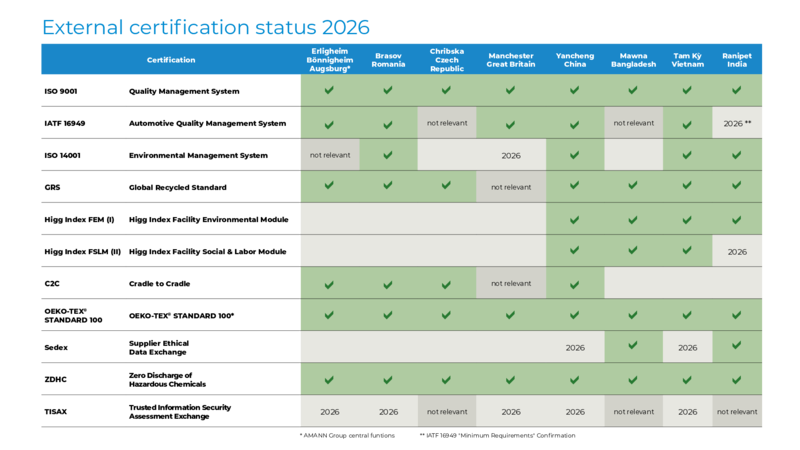
AMANN publishes its certifications and related information in its Certification overview and Download Center.
Key Takeaway
There is no single certification that covers every sustainability question. AMANN uses different standards, certifications and assessment systems depending on the product, location, customer requirement and purpose.
Explore next
Curious to learn more?
→ What is responsible chemical management?
Quick facts
| Property | Value |
|---|---|
| Topic | Certifications, standards and assessment systems |
| Main purpose | Support quality, safety, sustainability and transparency |
| Areas covered | Products, production sites, management systems and supply chains |
| Examples | ISO 14001, OEKO-TEX® STANDARD 100, Global Recycled Standard (GRS), Higg and Sedex |
| Important distinction | Not every system is a certification – some are standards, assessments or platforms |
| Site-specific | Requirements and certifications can differ between AMANN locations |
| Product relevance | Certifications can provide information on product safety, recycled content and other defined characteristics |
| Customer relevance | Can support supplier qualification, sourcing decisions and customer requirements |
| AMANN approach | Apply relevant standards and certifications where they create value or support specific requirements |
| Key principle | The right tool for the right question |
Also known as
Technical terms
- Certifications and standards
- Sustainability certifications
- Product certification
- Management system certification
- Environmental certification
- Product standards
- Sustainability standards
- Social compliance standards
- Supply chain standards
- Recycled content certification
- Third-party certification
- Conformity assessment
- Facility assessment
- Supplier assessment
- Management system standard
- Responsible sourcing standard
- Certification scheme
Assessment system
Common descriptions
People often search for:
- Certifications and standards
- Sustainability certifications
- AMANN certifications
- AMANN standards
- Certifications for textile products
- Textile certifications
- Sustainability standards for textiles
- Product certifications
- Factory certifications
- Environmental management certification
- Recycled material certification
- Supply chain assessments
- How textile certifications work
- What is the difference between a certification and a standard?
- Which certifications are relevant for textile suppliers?
- How to compare sustainability certifications
- ISO 14001 vs. Higg
- GRS certification for recycled materials
- OEKO-TEX® certification for textiles
Sedex vs. SMETA
Alternative terminology
Different industries and software providers may use slightly different terminology.
- Certification schemes
- Certification frameworks
- Sustainability schemes
- Compliance standards
- Verification schemes
- Assessment frameworks
- Assurance systems
- Conformity assessment systems
- Sustainability assessment systems
International terminology
| Language | Common terminology |
|---|---|
| English | certifications and standards; sustainability certifications; product certification; management system certification |
| German | Zertifizierungen und Standards; Nachhaltigkeitszertifizierungen; Produktzertifizierung; Managementsystem-Zertifizierung |
| French | certifications et normes; certifications de durabilité; certification des produits; certification des systèmes de management |
| Italian | certificazioni e standard; certificazioni di sostenibilità; certificazione di prodotto; certificazione dei sistemi di gestione |
| Spanish | certificaciones y normas; certificaciones de sostenibilidad; certificación de productos; certificación de sistemas de gestión |
| Chinese | 认证和标准; 可持续发展认证; 产品认证; 管理体系认证 |
| Vietnamese | chứng nhận và tiêu chuẩn; chứng nhận bền vững; chứng nhận sản phẩm; chứng nhận hệ thống quản lý |
FAQ
-
Standards define requirements or criteria for a specific topic, while certifications provide formal confirmation that defined requirements have been assessed according to a specific scheme or standard.
-
No. Some are standards, some are assessment systems and some are platforms for sharing information. Sedex, for example, is a platform rather than a certification.
-
A certification formally confirms conformity with defined requirements under a certification scheme. An assessment evaluates performance against defined criteria and may result in a report, score or corrective action plan.
-
Different systems address different questions. AMANN therefore selects standards and assessment systems according to factors such as product, location, customer requirements, regulatory context and sustainability objectives.
-
ISO 14001 provides a framework for environmental management systems. It supports systematic identification of environmental impacts, target setting, monitoring and continuous improvement.
-
OEKO-TEX® STANDARD 100 tests textile products and their components for harmful substances according to defined criteria. The applicable requirements depend on the product and its product class.
-
The GRS includes requirements for recycled content and traceability along the supply chain, together with social, environmental and chemical requirements.
-
AMANN publishes its certifications and related information in its Certification overview and Download Center. The certifications and standards that apply depend on the relevant product, production site or management system.