
Intro
Elastic materials require seams that can extend with the fabric without restricting movement or failing under strain. This is essential in sportswear, underwear, lingerie, stretch denim, workwear with stretch zones and many knitted products.
Seam elasticity is not determined by thread elongation alone. Stitch type, stitch density, seam construction, thread tension and material recovery all influence how far a seam can stretch and how well it returns to its original shape. An elastic sewing thread can provide an additional stretch reserve, but it should be selected for the specific seam requirement rather than assumed to be necessary for every seam in the product.
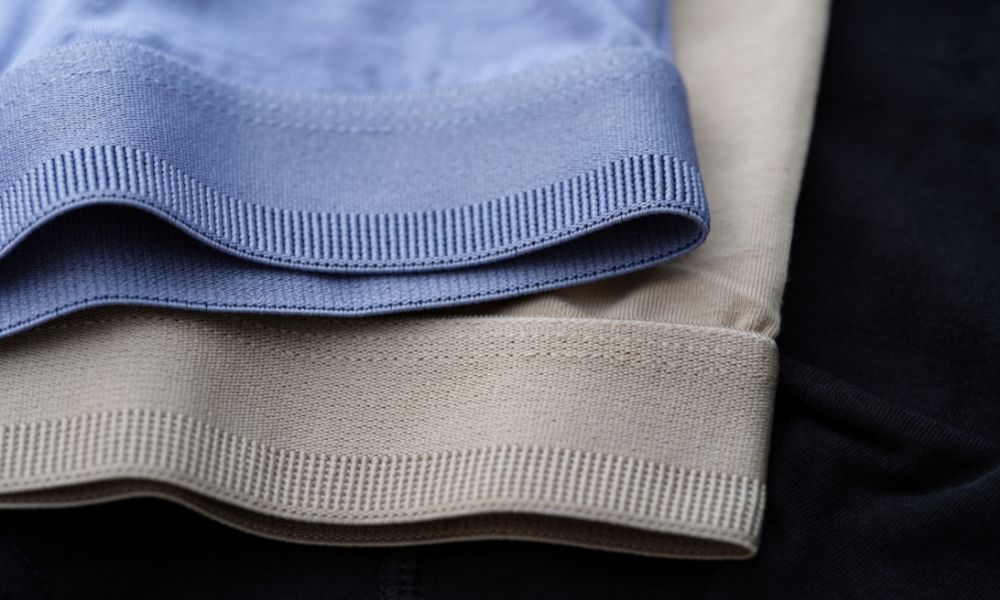
Thread elongation and seam elasticity are not the same
A highly extensible thread can support elastic seam performance, but the final result is created by the complete stitch system. Chainstitch and coverstitch constructions generally provide more extensibility than a tightly adjusted lockstitch. At the same time, excessive thread tension or insufficient stitch density can limit the available stretch reserve.
Key factors to consider
- Required seam elongation: Define how far the seam must stretch in real use and compare this with the elongation of the material.
- Recovery: A seam should not only extend; it should also return without remaining loose, wavy or permanently elongated.
- Stitch type: Choose a stitch formation that provides the required thread reserve and movement for the seam position.
- Thread tension: Overly high tension reduces the amount of thread available within the seam and can restrict elasticity.
- Seam position: Waistbands, hems, side seams and decorative seams may require different solutions within the same garment.
Typical applications
- Leggings and yoga wear
- Bras, underwear and lingerie
- Sports shirts and base layers
- Stretch denim
- Workwear with stretch panels
- Children’s clothing
- Knitted garments
Find the right AMANN solution
| AMANN Product | Recommended use within this solution |
|---|---|
| Sabaflex | Highly elastic PTT continuous filament thread that provides an additional stretch reserve for elastic materials and seams. |
| Sabaflex Recycled | Highly elastic continuous filament made from 100% recycled PBT; available as GRS certified. |
| Sabasoft | Soft texturised microfilament for elastic close-to-skin seams where both comfort and flexibility are important. |
| Sabatex Soft | Extra-soft bulk thread for elastic serging and coverstitch seams, especially in lingerie and activewear. |
| Saba / Saba Recycled | Versatile core spun alternatives for seam positions where moderate elasticity, strength and a textile appearance are required. |
Important technical note
The suitability of a sewing thread depends on the complete combination of material, seam construction, stitch type, needle, machine settings and finishing processes. Individual sewing trials and application-specific testing are recommended before production.