
Intro
Choosing a sewing or embroidery thread in the right colour may appear to be a simple visual task. In practice, however, visual assessment is influenced by the light source, surrounding colours, sample size, viewing angle, surface appearance and the observer. Fatigue and differences in colour vision can also affect a decision. Digital colour matching supplements expert judgement with objective measurement. It creates a common numerical language for colour and makes comparisons more transparent, repeatable and easier to communicate across locations and companies.
How a colour becomes digital data
A spectrophotometer illuminates a sample under defined conditions and measures how much light is reflected at different wavelengths of the visible spectrum. The resulting reflectance curve is a distinctive spectral signature—often described as the fingerprint of a colour. Perfect white would reflect all incoming visible light, while perfect black would absorb it. A coloured object absorbs selected wavelengths and reflects others. By recording this behaviour, the device captures information that is more precise and transferable than a photograph or an on-screen colour impression.
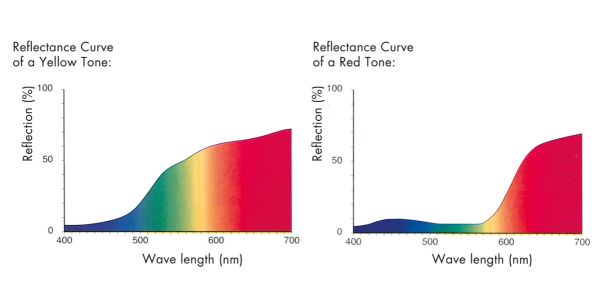
The measurement can then be represented in a standard colour space. In the CIELAB model, L* describes lightness, a* locates the colour between green and red, and b* locates it between blue and yellow. Together, these coordinates make it possible to describe the direction of a colour difference rather than relying on expressions such as “slightly warmer” or “a little darker”.
Understanding Delta E
Delta E, written as ΔE, expresses the total distance between two colours as a single value. Different calculation methods for ΔE exist; therefore, colour differences should only be compared when the same method and measurement conditions are used. AMANN uses the Delta E 2000 formula while working with DMIx. In general, the lower the value, the closer the match. However, ΔE alone does not explain why two samples differ. A meaningful evaluation therefore also considers the individual lightness, red–green and yellow–blue differences, the reflectance curves, the material and the agreed tolerance. The appropriate tolerance is application-specific: a visible decorative seam, a concealed construction seam and a safety-critical component may require different assessment criteria.
A practical digital workflow
A digital colour-matching process can start in several ways. A customer can measure a physical fabric with a compatible device, upload an existing spectral file such as a QTX file, or use a defined textile colour standard. The target data is then compared with spectral colour libraries to identify the closest available thread colours. The results can be reviewed side by side, documented and exported for communication with colleagues and suppliers.
Not every physical sample is suitable for reliable measurement, and surface properties can influence the result. Glossy materials may alter reflection; mélange, shepards plaid and other multicoloured patterns are averaged by the instrument rather than measured as separate colour areas. Very thin fabrics need to be folded several times to prevent the background from showing through, while printed areas must be large enough to cover the measurement lense. Where these conditions cannot be met, visual assessment of the original material remains essential.
With the DMIx Cloud, customers can digitally compare their target colour with colours from AMANN collections. Depending on the customer’s existing digital environment, access can be connected through ColorDigital or provided for colour matching with the AMANN range. The cloud-based approach supports collaboration across the textile value chain and permits colour decisions to be integrated into wider digital workflows.
Customer benefits
- Faster decisions: digital comparison can reduce the time spent searching through physical colour cards and exchanging samples.
- Greater consistency: defined measurement conditions and spectral data support repeatable decisions across teams and locations.
- Clearer communication: numerical results, directional colour differences and reflectance curves reduce ambiguity.
- Lower sample and shipping effort: digital data can reduce the number of physical submissions needed during early selection stages.
- Better integration: colour information can become part of a connected digital development and sourcing process.
- More sustainable workflows: fewer physical samples and shipments can save materials, time and transport.
Quick facts
| Property | Value |
|---|---|
| Topic | Digital Colour Matching and Colour Measurement |
| Main purpose | Support reliable, objective and repeatable colour decisions |
| Key technology | Spectrophotometry |
| Measurement output | Spectral reflectance curves and colour coordinates |
| Main colour space | CIELAB (L*, a*, b*) |
| Key metric | Delta E (ΔE), expressing the distance between two colours |
| AMANN's calculation method | Delta E 2000 (ΔE00) when working with DMIx |
| Digital workflow | Measure a sample, upload spectral data or select a defined textile colour standard |
| Digital solution | DMIx Cloud for comparing target colours with colours from AMANN collections |
| Main benefits | Faster colour selection, consistent communication, fewer physical samples and more integrated digital workflows |
Also known as
Technical terms
- Digital colour matching
- Digital colour measurement
- Instrumental colour measurement
- Spectrophotometry
- Spectral colour matching
- Digital colour management
- CIELAB colour space
- Delta E (ΔE)
- Delta E 2000 (ΔE00)
- Spectral reflectance
- Reflectance curve
- Digital colour library
- Textile colour standards
Cloud-based colour matching
Common descriptions
People often search for:
- What is digital colour matching?
- How does digital colour matching work?
- How is colour measured digitally?
- What is a spectrophotometer?
- What is a spectral reflectance curve?
- What is the CIELAB colour space?
- What do L*, a* and b* mean in colour measurement?
- What is Delta E in colour matching?
- What is the difference between Delta E and Delta E 2000?
- What does a low Delta E value mean?
- How can textile manufacturers match sewing thread colours digitally?
- How can digital colour matching improve colour consistency?
- How can digital tools reduce physical colour samples?
- What is cloud-based colour matching?
How can I compare fabric colours with sewing thread colours digitally?
Alternative terminology
Different industries and software providers may use slightly different terminology.
- Colour perception
- Colour science
- Colour tolerances
- Colour difference
- Colour libraries
- Spectral data
- QTX files
- Digital product development
- Colour approval
- Textile sourcing
- Sustainable digital workflows
International terminology
| Language | Common terminology |
|---|---|
| English | Digital colour matching, colour measurement, colour difference |
| German | Digitaler Farbabgleich, Farbmessung, Farbunterschied |
| French | Correspondance numérique des couleurs, mesure des couleurs, différence de couleur |
| Italian | Abbinamento digitale dei colori, misurazione del colore, differenza cromatica |
| Spanish | Igualación digital del color, medición del color, diferencia de color |
| Chinese | 数字化颜色匹配、颜色测量、色差 |
| Vietnamese | Phối màu kỹ thuật số, đo màu, độ lệch màu |
FAQ
-
Digital colour matching uses instrumental measurements and digital colour data to compare colours objectively. It supplements visual assessment and helps teams communicate colour requirements more consistently across locations and companies.
-
A spectrophotometer illuminates a sample under defined conditions and measures the light reflected at different wavelengths. The resulting reflectance curve describes the sample's spectral characteristics and can be used to compare colours more precisely than photographs or screen impressions.
-
CIELAB is a colour model that represents colour using three coordinates: L\* for lightness, a\* for the green–red axis and b\* for the blue–yellow axis. These values help describe and communicate colour differences numerically.
-
Delta E expresses the overall difference between two colours as a numerical value. Generally, a lower value indicates a closer match. However, results depend on the calculation method and measurement conditions, and acceptable tolerances vary by application.
-
Delta E 2000 is a formula for calculating colour differences. AMANN uses this formula when working with DMIx. For meaningful comparisons, the same calculation method and measurement conditions should be used.
-
Digital tools can compare measured fabric colours or existing spectral data with colour libraries to identify suitable thread colours. The results can be documented and shared, supporting colour selection and communication. The actual materials should still be assessed where surface appearance or measurement limitations may affect the result.
-
No. Gloss, transparency, multicoloured patterns and sample size can affect measurement reliability. Thin fabrics may need to be folded to prevent the background from influencing the reading, while printed areas must be large enough to cover the instrument's measurement aperture. Visual assessment remains important when a sample cannot be measured reliably.
-
Cloud-based solutions such as DMIx Cloud can support digital comparison of target colours with colours from AMANN collections. They can help speed up colour selection, improve collaboration, reduce the need for physical samples and shipments, and integrate colour information into wider digital workflows.